
Part six of the seven-day logbook of the yacht Bonaca, sailing from Rijeka to Split. After the silence of the Kornati, today we sail back to the mainland and up a river into green country.
Missed the previous entry? Read Part 5 of the Adriatic Logbook first.
Ship’s Log
- Day: Day 6 of 7
- Leg: Kornati → Šibenik → Skradin (Krka river)
- Distance: approx. 30 nautical miles
- Wind & weather: Light NW in the morning, maestral 12–15 knots midday, calm on the river; sunny, 32 °C
Goodbye, Stone Islands
We dropped the buoy at seven and motored out through the Kornati in the cool morning air. Niko made pancakes underway, which is a skill I did not know he had and now expect daily. Once we were clear of the islands the maestral filled in and we had a fine broad reach toward the coast, Bonaca leaning just enough to make the coffee cups slide.
St. Anthony’s Channel and the Fortress
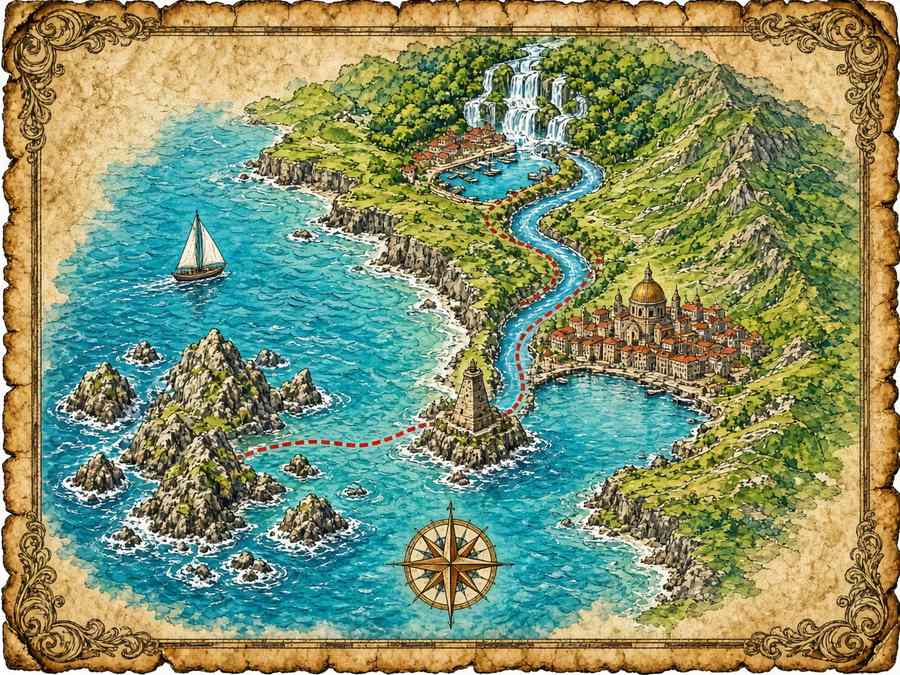
Šibenik does not sit on the open sea. It hides behind a narrow, twisting channel, the Channel of St. Anthony, about a mile long and lined with pine woods. At its entrance stands the fortress of St. Nicholas, a massive sixteenth-century Venetian sea fortress built right at the water’s edge to guard the approach. Since 2017 it has been part of a UNESCO World Heritage site covering the Venetian defensive works of the Adriatic. Sailing past it, close enough to see the shape of every stone, felt like entering a city by its front door.
Insider tip for the channel: it is narrow and busy, with ferries and tour boats coming the other way, and there is often a current. Keep to the right side, keep your speed modest, and do not try to sail it under canvas alone if the wind is fluky between the hills. We dropped the sails before the entrance and motored through, all three of us on deck, grinning and pointing like children.
The Cathedral of St. James
We tied up on the Šibenik waterfront for a few hours and climbed into the old town, a tangle of white stone stairways, arches and tiny squares. At its heart is the Cathedral of St. James, built between 1431 and 1535 entirely of stone, roof and dome included, and listed as a UNESCO World Heritage Site since 2000. Its builders, above all the master Juraj Dalmatinac, used a clever technique of interlocking stone slabs, which is why the building looks almost weightless.
But what everyone comes to see runs around the outside of the apses: a frieze of seventy-one carved stone heads. Old men, young women, frowning faces, laughing faces, a man who looks like he just stepped on a sea urchin. They are believed to be portraits of ordinary townspeople of the fifteenth century. A local guide with dark hair and a wonderful sense of humor walked us around them and invited us to find our “stone twins”. Maya found hers immediately. Niko’s was the one with the deeply suspicious expression. Mine, apparently, is the one who looks like she is about to tell a long story.

Up the River
In the early afternoon we cast off again and headed up the Krka. The river meets the sea in a long, deep estuary, and sailing up it feels like entering a different country: green hills, reeds, herons, and calm water that turns from blue to emerald. Insider fact: the upper layer of the estuary is fresh or brackish river water, lying on top of heavier salt water below. You can sometimes feel the change when you swim, warm and soft on top, cooler and saltier below.
We passed under the high road bridges, crossed the wide lake of Prokljan, and finally arrived at Skradin, a sleepy little town at the edge of the Krka National Park, with a marina full of yachts and a bell tower poking above the red roofs.
The Krka Waterfalls
From Skradin, park boats run upriver to Skradinski buk, the most famous of the Krka waterfalls. It is a series of travertine terraces where the river tumbles over dozens of cascades into green pools, surrounded by a wooden walkway through the trees. The travertine is formed slowly by mosses and algae trapping limestone from the water, so the whole waterfall is quite literally still growing.
One important update for anyone who has read old travel guides: swimming at Skradinski buk is no longer allowed. It was banned to protect the fragile travertine barriers, and the rangers are firm about it. We were honestly happy to just walk, look and listen. The roar of the water, the mist and the sunbeams through the leaves were more than enough.

Skradin Risotto
Back in Skradin we ate the town’s famous dish, Skradin risotto. It is made with veal and slow-cooked for many hours, stirred patiently until it becomes rich, creamy and deeply savory. Locals told us that it was traditionally cooked by men for big celebrations and that the recipe is something of a family secret. We asked for the secret. We did not get it. We did get second helpings.
Evening Log
Tomorrow is the last day, and a long one. It will take us down the coast past Primošten and Trogir and into Split. Nobody wanted to say it out loud, so instead we sat on the foredeck talking about everything else: about the octopus, the Sea Organ, Ante’s laugh and the dolphins. Then Niko said quietly, “Best crew I’ve ever had.” Maya said, “We’re the only crew you’ve ever had.” He said, “Still.”
Log closed. Engine hours: 4.1 · Sailing hours: 3 · Stone faces counted: 71 · Swims: 1 (in the sea before Šibenik, not at the waterfalls) · Tomorrow: Primošten, Trogir and the final run into Split.
Part 6 of 7. The next logbook entry, Day 7, follows tomorrow.
About the Author



1 thought on “Adriatic Logbook, Day 6: Kornati to Šibenik and Skradin – A Fortress, Seventy-One Stone Faces and the Krka Falls”