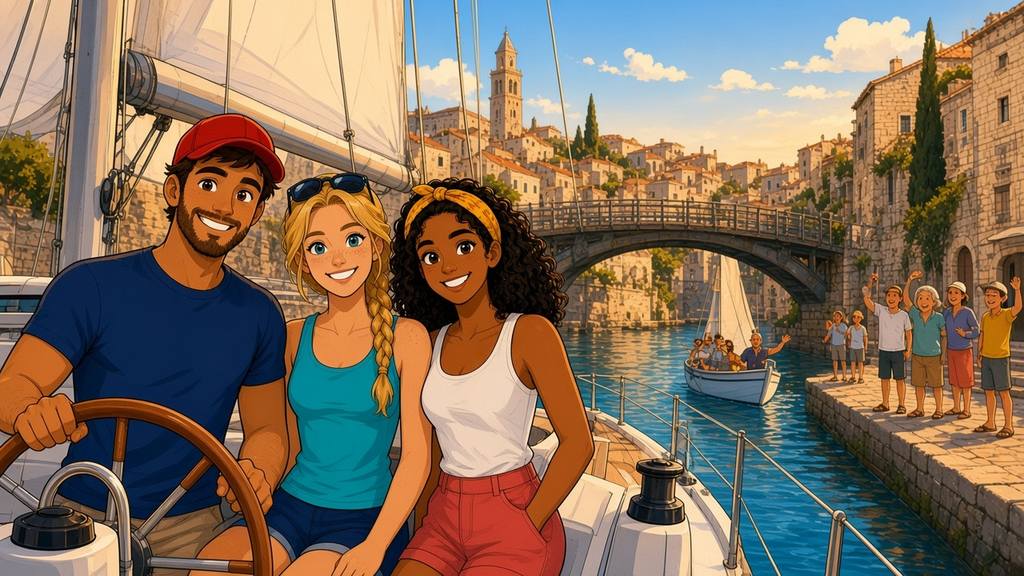
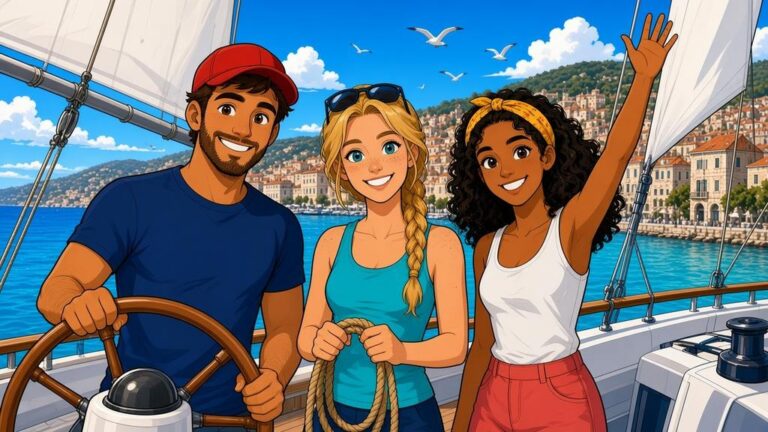
Part two of the seven-day logbook of the yacht Bonaca, sailing from Rijeka to Split with Niko, Maya and me, Lena. Yesterday we crossed the Kvarner Bay to Cres. Today we head south along the island and squeeze through a canal the Romans dug.
Missed the previous entry? Read Part 1 of the Adriatic Logbook first.
Ship’s Log
- Day: Day 2 of 7
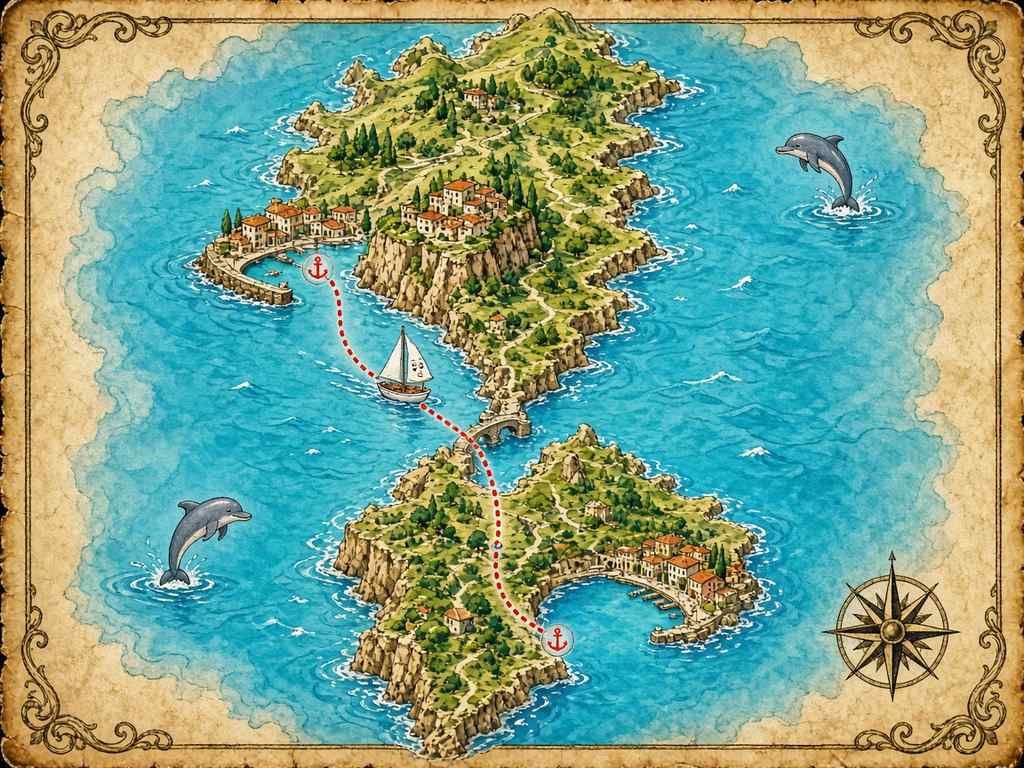
- Leg: Cres town → Lubenice bay → Osor → Mali Lošinj
- Distance: approx. 30 nautical miles
- Wind & weather: Light and variable in the morning, NW maestral 10–14 knots from early afternoon; sunny, 29 °C, sea slight
Morning Run and a Plan with a Deadline
Maya woke us at six with the words “sunrise run”, which is not a phrase anyone wants to hear on holiday. We ran anyway, up through the lanes of Cres town and along the olive groves above the bay, then jumped into the harbor-side sea to cool off. Breakfast was scrambled eggs, tomatoes and the last of the Rijeka bread.
Today had a deadline. Between the islands of Cres and Lošinj lies a narrow channel at the old town of Osor, crossed by a swing bridge. The bridge opens only twice a day, at nine in the morning and at five in the afternoon, and only briefly. Miss the evening opening and you either wait until morning or sail all the way around Lošinj. So the plan was simple: leisurely morning on the west coast of Cres, be at Osor well before five.
Lubenice: A Village on the Edge
We motor-sailed south along the west coast of Cres, a long wall of rock and scrub with hardly a house in sight. Then, high up on the cliff, appeared Lubenice: a tiny stone village perched almost four hundred metres above the sea, looking as if someone had placed it there carefully and then forgotten to build the road. It is one of the oldest settlements on the island, and from the water it looks completely unreal.
Below the cliff lies a white pebble beach with water so clear that our anchor looked like it was floating in air. We dropped the hook in sand, well away from the rocks, let out plenty of chain and snorkelled back to check it was properly dug in. Insider tip of the day: always look at your anchor after setting it if the water allows. A five-minute swim is cheaper than a night of worrying, and much cheaper than a drifting boat.
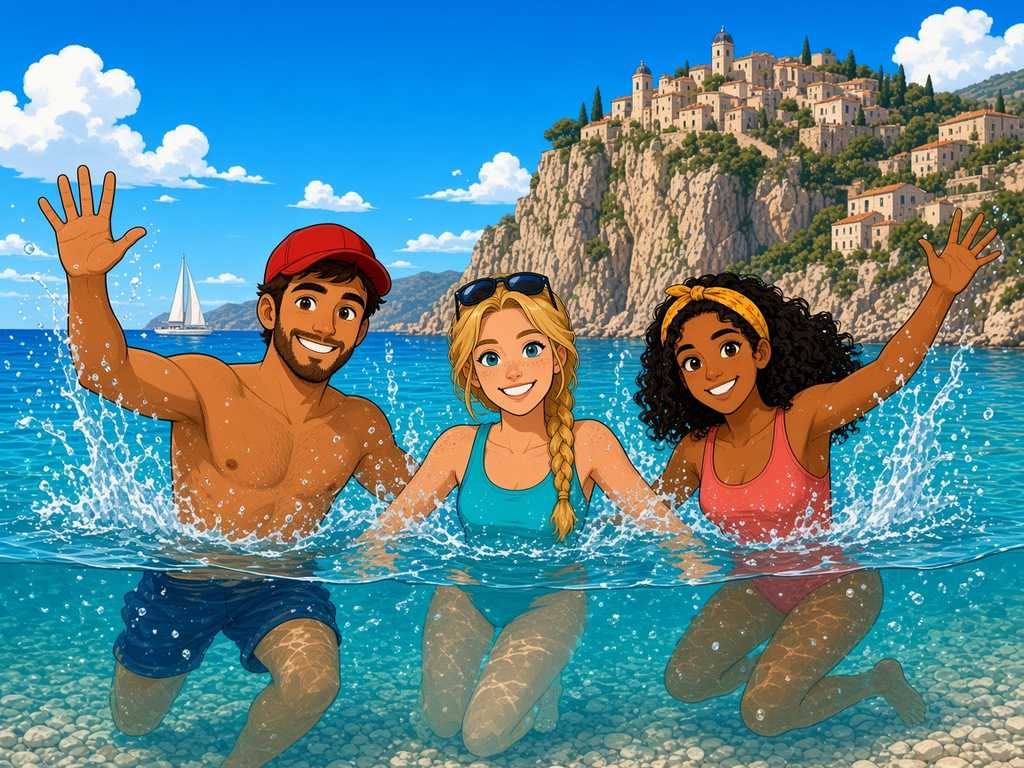
We spent two hours swimming, splashing and arguing about whether climbing the steep path up to the village counted as exercise or as madness. Maya and Niko did half of it and came back glowing. I stayed below with a book and a peach, which I consider an equally valid form of self-care.
The Osor Bridge
At half past three the maestral filled in from the northwest, the steady afternoon breeze of a Croatian summer, and we had a lovely sail south. We arrived off Osor just after four, and we were not alone. A small fleet of yachts was circling at the northern entrance, all with the same idea and the same slightly nervous skippers.
There are a few things worth knowing here. The channel is very narrow, and the current through it can be strong, several knots when the wind has been blowing for a while. Boats coming from the south usually have priority, so if you arrive from the north, as we did, you wait your turn. Have fenders out on both sides, the engine running and someone at the bow. Niko briefed us like a pilot before takeoff. Maya took the bow, I took the fenders, and we lined up behind a beautiful old steel ketch flying a Dutch flag.
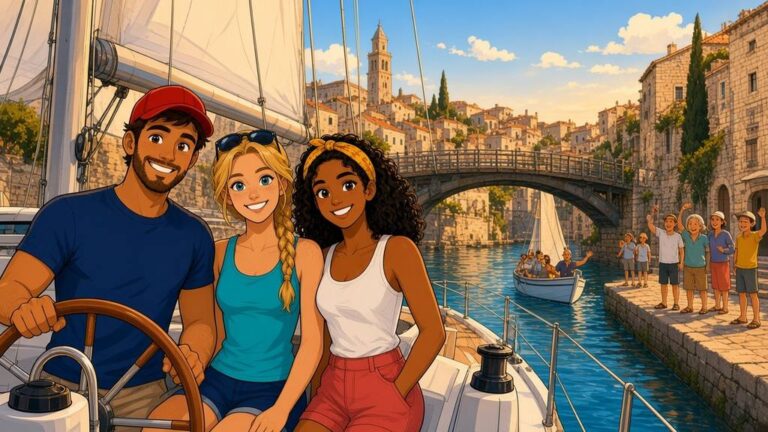
At five sharp the bridge swung open, the boats from the south came through, and then it was our turn. We motored slowly through a gap only a little wider than a tennis court, with people on the quay watching, waving and taking photos. The Dutch couple on the ketch, Wim and Annelies, both in their sixties and both permanently grinning, cheered us through like we had won a race.
Mali Lošinj
From Osor it was an easy run down the Lošinj channel to Mali Lošinj, a busy, cheerful harbor town at the end of a long, sheltered bay. Its pastel houses wrap around the water and the hills behind are covered in pines that were planted generations ago and now perfume the whole town on a warm evening.
We found a berth on the town quay and went straight to the museum of the Apoxyomenos, a life-size ancient Greek bronze statue of an athlete scraping oil and dust from his body. It spent around two thousand years on the seabed off a small islet near Lošinj before a diver spotted it in 1999. Seeing it in its dark, quiet gallery after a day on the water felt strangely personal, an athlete from the sea, brought back to land.
Dolphins!
Wim and Annelies invited us for drinks on their ketch, and Wim told us that the waters around Cres and Lošinj are home to a resident population of bottlenose dolphins, studied by researchers for decades. “Keep your distance if you see them,” he said, “and let them choose whether they want to come closer.”
They chose. On a short sunset sail around the bay, two dolphins surfaced beside us, then rolled and leaped off the bow wave as if showing off. We cut the engine, kept our course steady and just watched. Nobody spoke for a full minute, which for this crew is a record.

Evening Log
Dinner was black risotto and grilled squid at a small family place in the back lanes, followed by ice cream on the quay. Niko declared that the bridge passage was the best piece of boat handling of his career. Maya pointed out that his career is six years long. I wrote this entry with my feet on the rail and the smell of pine drifting across the harbor.
Log closed. Engine hours: 3.4 · Sailing hours: 4 · Swim stops: 1 · Dolphins: 2 · Tomorrow: a long passage south toward Zadar, fishing lines out.
Part 2 of 7. The next logbook entry, Day 3, follows tomorrow.
About the Author



1 thought on “Adriatic Logbook, Day 2: Cres to Mali Lošinj – A Cliff Village, a Swing Bridge and Dolphins at Sunset”